Most About pages are about the wrong thing. Here’s a simple formula that flips the script and makes visitors feel like you’re talking directly to them.
-
Understand why most about pages do not work
-
Apply the formula that works
-
Learn what to include (And what to leave out)
-
Common mistakes that cost you clients
-
Write it when you feel awkward about self-promotion
How to Write an About Page That Actually Gets People to Hire You
You finally sat down to write your About page. You opened a blank document, typed “About Me” at the top, and then stared at the cursor for twenty minutes. Eventually you wrote something like: “I have been passionate about [your field] since I was young. After graduating from [school], I worked at [places] for [number] years. In [year], I decided to follow my dream and start my own business.”
It is factual. It is polite. And it is doing almost nothing to get you clients.
Here is the uncomfortable truth about About pages: the best ones are not really about you. They are about your customer. More specifically, they are about your customer’s problem, your understanding of that problem, and why you are the right person to solve it. Your story matters — but only as evidence that you get it and you can help.
Why Most About Pages Do Not Work
The most common About page reads like a resume. It lists credentials, tells a career story chronologically, and ends with something vague like “I am passionate about helping people reach their potential.”
The problem is not that these details are wrong. It is that they answer the wrong question. The person reading your About page is not asking “What is this person’s life story?” They are asking “Can this person help me with my specific problem?” and “Do I trust them enough to spend money?”
A resume-style About page puts all the weight on your credentials. But credentials alone do not build connection. A person with a wall of certifications can still feel cold and unapproachable. Meanwhile, someone who clearly understands the reader’s frustration and speaks to it directly will feel like someone worth hiring — even with a shorter resume.
The second common mistake is making the About page too short or too casual. “Hey, I am [name] and I love what I do! Let us work together!” is friendly, but it gives the visitor nothing to hold onto. No reason to trust you. No evidence that you understand their world.
The Formula That Works
A strong About page follows a pattern that puts the customer first while still telling your story. Think of it as five sections that flow naturally from one to the next.
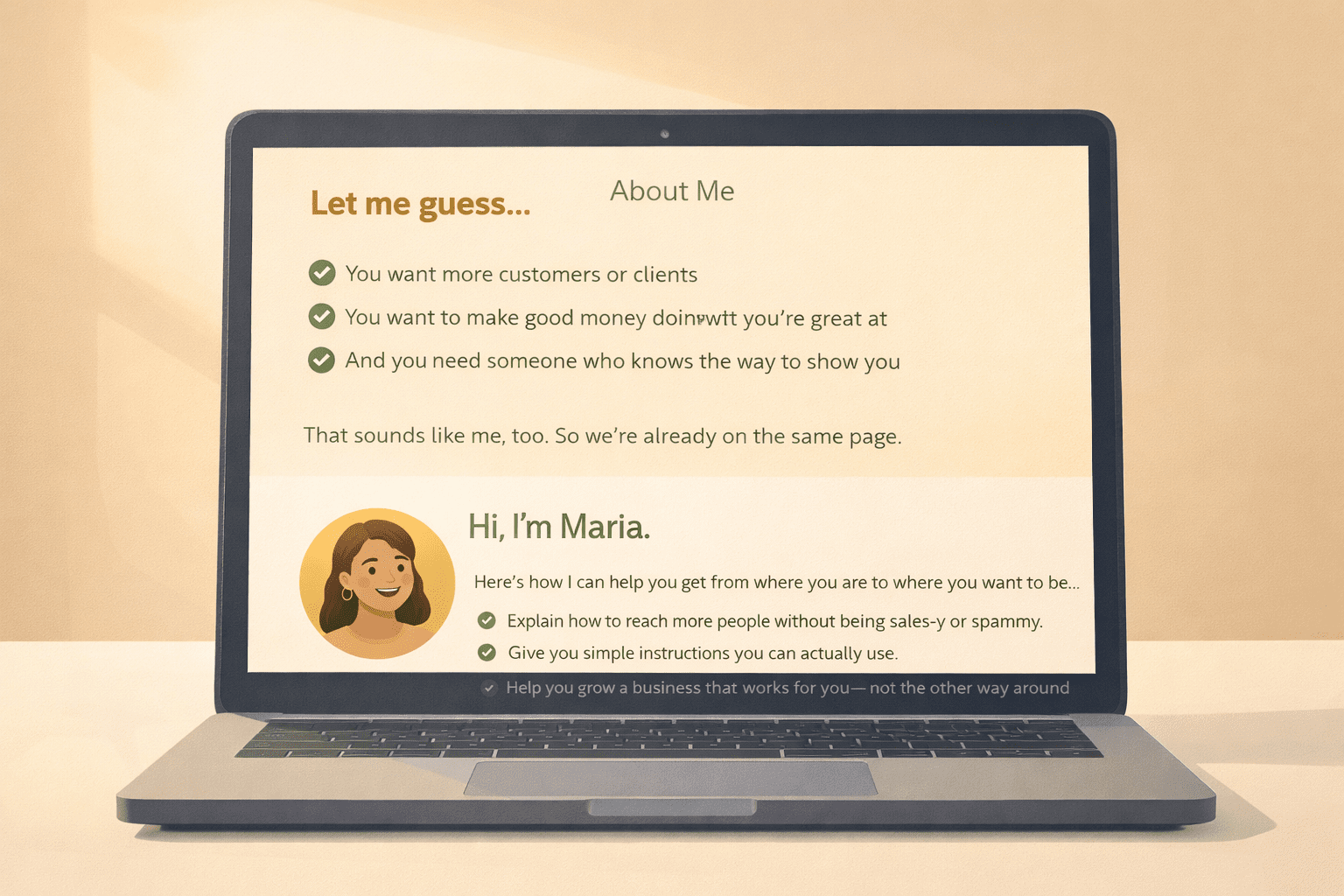
Section one: Start with their problem. Open with a statement or question that shows you understand what brought them to your site. This is not about you yet. It is about them feeling seen.
Something like: “You have been running your business for a while now, and the hustle that got you here is starting to wear you down. You know you need better systems, but every time you sit down to figure it out, the options feel overwhelming and the tech feels confusing.”
This immediately tells the reader “this person gets my situation.” That alone builds more trust than any degree or certification.
Section two: Show that you understand. Expand on the problem with specific details that prove you are not guessing. Mention the feelings, frustrations, and failed attempts that your ideal customer experiences. The more specific you are, the more they feel like you are talking directly to them.
“Maybe you have tried a few different tools. Maybe you started building a website and gave up halfway through. Maybe you have spent hours watching tutorials that left you more confused than when you started.” Each line should make the reader nod and think “yes, that is exactly what happened.”
Section three: Introduce yourself as the guide. Now you enter the story — not as the hero, but as someone who understands because you have been there, or because you have helped people through this exact situation dozens of times. This is where your background becomes relevant, but only the parts that connect to their problem.
“I have spent the last ten years helping small business owners build the online presence they need without the tech headaches they dread. I got into this work because I watched talented people struggle with tools and systems that should have been simple — and I knew there was a better way.”
Notice: no chronological career history. No list of degrees. Just the part of your story that matters to the reader.
Section four: Credibility markers. Now sprinkle in the proof. This is where specific numbers, notable clients, certifications, media mentions, or years of experience belong. But present them as evidence, not a brag list.
“Over 200 small businesses launched with my help. Featured in [publication]. Certified in [relevant thing].” Keep it tight. A few strong proof points are more persuasive than a wall of text.
Section five: The next step. End with a clear call to action. Not “feel free to reach out.” Something specific: “Ready to get your website working for you? Book a free 20-minute call and let us figure out the right plan for your business.”
What to Include (And What to Leave Out)
Include: Your first name (people hire people, not businesses). A photo of you — ideally warm and professional, not stiff or overly posed. The specific problem you solve. Who you solve it for. A brief version of why you do this work. One to three credibility markers. A clear CTA.
Leave out: Your entire career history. Childhood stories (unless directly relevant). Generic statements like “I am passionate about helping people.” Jargon or industry terms your customer would not use. Anything that centers you instead of the reader.
A good test: read your About page and count how many times it says “I” versus “you.” If “I” dominates the first half of the page, it needs rewriting. The “you” should come first and come often.
Common Mistakes That Cost You Clients
The invisible About page. Some business owners skip it entirely or bury it. Your About page is typically the second or third most visited page on your site. People want to know who they are buying from. Make it easy to find.
The team page disguised as an About page. If you have a team, great — but lead with the story and value first. A grid of headshots with titles does not tell a visitor why they should care. Give them a reason to care, then introduce the people.
No photo. Trust is visual. A page with no face feels anonymous. You do not need a professional headshot — a well-lit, friendly photo taken on a phone works fine. The goal is to look like a real person someone would want to work with.
Ending without a CTA. If someone reads your entire About page, they are interested. Do not make them hunt for the next step. Put a button or a link right there.
Writing It When You Feel Awkward About Self-Promotion
If writing about yourself feels uncomfortable, try this trick: pretend you are writing about a friend. Someone you admire and respect, whose work you have seen up close. Describe what that person does, who they help, and why they are good at it.
Then swap in your own details. The words will sound warmer and more confident than anything you would write while staring at the blank page and thinking “what do I say about myself?”
Another approach: ask a happy client to describe what you do and why they hired you. Their words are often better than anything you would come up with on your own — and you can weave their language directly into your About page.
The Action Step
Open your current About page right now. Read it through the eyes of someone who has never met you and is trying to decide whether to hire you or keep looking.
Does the first paragraph talk about their problem or your history? Does it make them feel understood or just informed? Is there a clear next step at the end?
If the answer to any of those is not what you want, rewrite the first two paragraphs using the formula above. Start with their world. Show them you get it. Then — and only then — tell them about you.
Your About page is not a biography. It is a trust-building conversation. And the best conversations always start with listening.
Try It With AI
Ready to put this into action? Copy any of the prompts below, paste it into ChatGPT or Claude, fill in the [BRACKETS] with your info, and hit send. You will have a solid first draft in minutes.
Prompt 1: Write or rewrite your about page following the five-section formula (their problem, show you understand, introduce yourself as guide, credibility markers, next step):
I run a [TYPE OF BUSINESS/SERVICE]. My ideal client is [DESCRIPTION OF WHO THEY ARE]. They typically struggle with [MAIN PROBLEM YOU SOLVE]. I want you to write an about page for my website that starts with their problem, shows I understand them, introduces my background, includes my strongest credibility markers, and ends with a clear call to action. Make it warm and direct—like I’m talking to a friend, not writing formally. Here’s what makes me different: [YOUR UNIQUE APPROACH/ANGLE].
Prompt 2: Rewrite the first two paragraphs of your current about page using the formula (start with reader’s problem, show you understand it, then introduce yourself):
I’m rewriting the opening of my about page. Right now it reads: [PASTE CURRENT TEXT]. Can you rewrite it so it starts with my ideal customer’s problem (they [THEIR PROBLEM]), shows I deeply understand that problem, and THEN introduces me and my background? Make it feel like I’m talking directly to someone who’s experiencing that exact issue. Keep my voice warm but professional.
