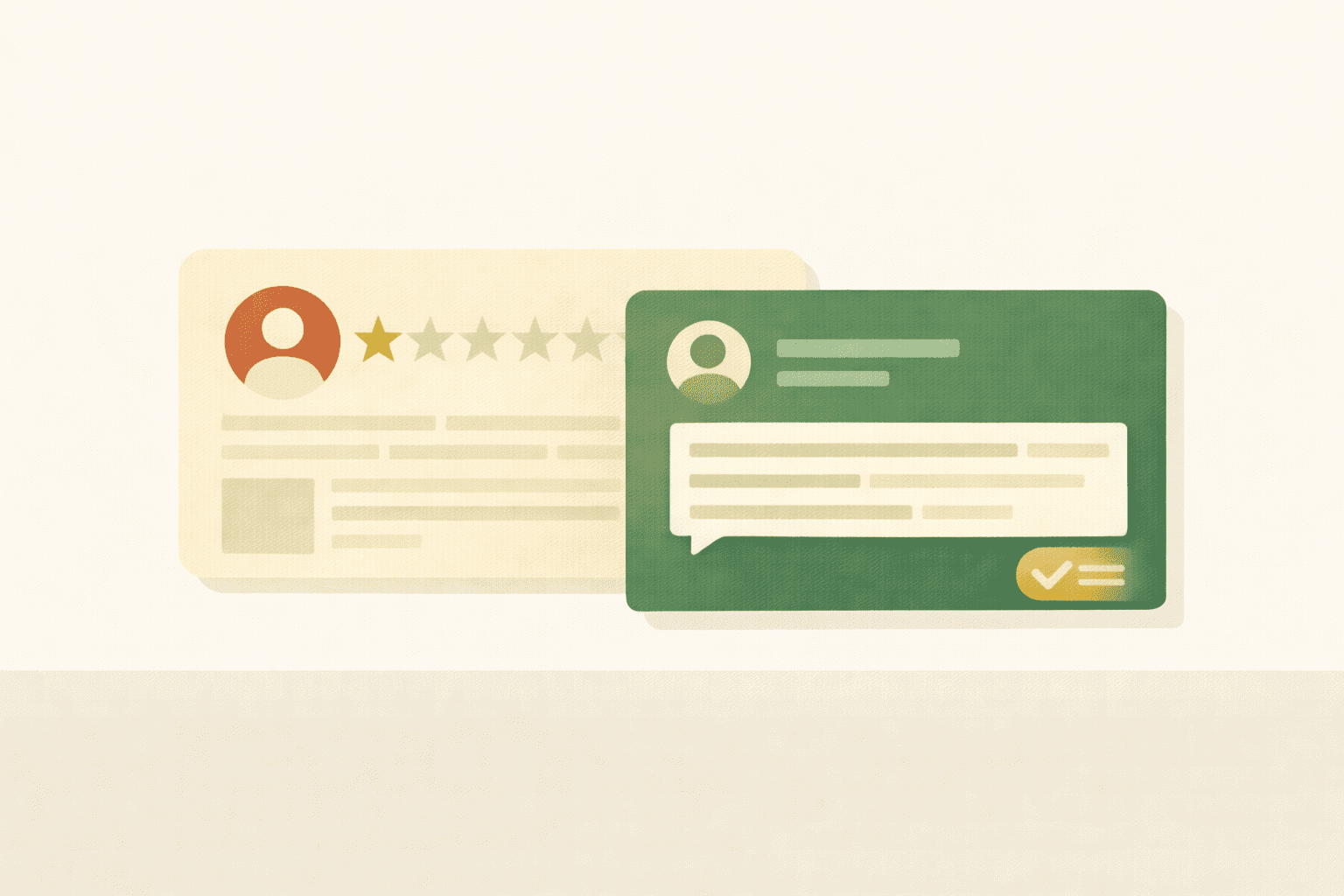
A bad review doesn’t have to tank your business. How you respond matters more than the review itself — here’s exactly what to say.
-
Understand why negative reviews are not the disaster you think
-
Apply the response framework
-
Know when the review is unfair
-
Turning bad reviews into business intelligence
-
See how to get more positive reviews
The notification comes in and your stomach drops. Someone left a negative review. Maybe it is one star. Maybe it is a long paragraph explaining everything they thought was wrong with your product or service. Maybe it is vague and unfair — “would not recommend” with no explanation.
Your first reaction is probably a mix of hurt, anger, and the urge to defend yourself publicly. That is normal. You pour yourself into your business. A negative review feels like a personal attack because, in a small business, the business is personal.
But how you respond in the next hour matters more than the review itself. A good response can actually increase trust with potential customers who read it. A bad response — or no response at all — can do more damage than the original complaint.
Why Negative Reviews Are Not the Disaster You Think
Here is something counterintuitive: a business with nothing but five-star reviews looks suspicious. People know that not every experience is perfect. When they see a flawless review profile, they wonder if the reviews are fake. A few negative reviews mixed in with mostly positive ones actually makes your overall rating more credible.
What potential customers pay attention to is not whether negative reviews exist. They pay attention to how you handled them. A business that responds to criticism with grace, empathy, and a clear desire to make things right signals something powerful: this business cares, and if something goes wrong with my order, they will take care of me too.
That means your response to a negative review is marketing. It is a public demonstration of your character. And people are watching.
The Response Framework
When a negative review comes in, give yourself a beat before you respond. Read it, absorb it, and let the initial emotional reaction pass. Then follow this framework.
Acknowledge the experience. Start by thanking the reviewer for their feedback and acknowledging their experience. “Thank you for sharing this. I am sorry your experience did not meet expectations.” This is not admitting fault for something you did not do. It is acknowledging that their experience was not what they hoped for, which is simply a fact.
Take responsibility where appropriate. If there was a legitimate issue — a delayed shipment, a quality problem, a miscommunication — own it. “You are right that the delivery took longer than it should have, and I understand how frustrating that is.” People respect businesses that take responsibility instead of making excuses.
Offer a resolution. If there is something you can do to make it right, say so. “I would love the chance to fix this. Please reach out to me directly at [email/phone] and I will make sure we get this resolved.” Moving the conversation to a private channel protects both parties and shows you are serious about following through.
Keep it brief and professional. Your response does not need to be long. Three to five sentences is usually enough. Avoid getting into a back-and-forth debate. Avoid defensive language. Avoid sarcasm, even if the review feels unfair. Every word you write is being read by future customers, not just the reviewer.
When the Review Is Unfair
Some negative reviews are inaccurate, exaggerated, or come from someone who was never a customer. This is maddening, but the approach stays mostly the same.
Respond calmly and factually. “I am sorry to hear about your experience. I was not able to find a matching order in our records — could you reach out directly so I can investigate?” This response tells other readers that you take complaints seriously while subtly indicating the review may not be legitimate.
If a review violates the platform’s guidelines — if it contains false claims, hate speech, or appears to be from a competitor — you can report it for removal. Most platforms will review flagged content, though the process can be slow. In the meantime, your professional response serves as your public defense.
What you should never do is attack the reviewer, call them a liar, or write a response dripping with passive aggression. Even if you are right, you lose. Future customers will side with the reviewer because nobody wants to buy from a business that fights with its customers in public.
Turning Bad Reviews Into Business Intelligence
Every negative review, fair or not, contains information. Look past the emotion and identify the actionable signal.
If multiple reviews mention slow shipping, that is a logistics problem worth solving. If someone complains about unclear sizing, that is a product listing that needs better detail. If a client says the project timeline was confusing, that is a communication process that could be improved.
Think of negative reviews as free consulting. Nobody enjoys receiving them, but the businesses that listen to them and make changes grow faster than the ones that dismiss them.
Keep a simple log of negative feedback — the complaint, the date, and what action you took. Over time, patterns emerge. When you notice a pattern, fix the root cause. When you fix the root cause, the complaints stop. That is the cycle.
How to Get More Positive Reviews
The best defense against the occasional negative review is a steady stream of positive ones. Most happy customers do not leave reviews unless you ask. So ask.
The best time to request a review is immediately after a positive interaction — when the product just arrived, when the service was just delivered, when the customer just expressed satisfaction. “I am so glad you are happy with it! If you have a moment, a quick review on [platform] would mean the world to me.”
Make it easy. Send a direct link to the review page. Keep the ask simple and pressure-free. Most people are happy to help a small business they like — they just need a gentle prompt and a convenient way to do it.
Over time, a healthy volume of positive reviews buries the occasional negative one and gives potential customers the confidence they need to choose you.
When to Let It Go
Not every negative review deserves a lengthy internal investigation. If a one-star review says “bad” with no explanation and the reviewer has no purchase history, respond briefly and move on. If someone leaves a negative review about something outside your control — like a weather delay or a platform glitch — acknowledge it, explain the situation without making excuses, and move on.
Your mental health matters. Ruminating on a single bad review when you have dozens of happy customers is a trap. Read it, respond professionally, look for any useful signal, and then redirect your energy to the people who love what you do.
The Action Step
Write your go-to negative review response template right now. Use the framework: acknowledge, take responsibility where warranted, offer a resolution, and keep it brief. Save it somewhere accessible so that the next time a negative review lands, you do not have to craft a response from scratch while your emotions are running high.
Then send a review request to your five most recent happy customers. A direct message, a follow-up email, or a text — whatever fits your relationship. Building that positive review momentum now means the next negative review will be a drop in an ocean of good ones. And that is exactly where you want it.
Try It With AI
Ready to put this into action? Copy any of the prompts below, paste it into ChatGPT or Claude, fill in the [BRACKETS] with your info, and hit send. You will have a solid first draft in minutes.
Prompt 1: Write your go-to negative review response template:
I run a [TYPE OF BUSINESS] and I want to create a template response for negative reviews that I can use quickly. The response should: 1) acknowledge the customer’s experience, 2) take responsibility where appropriate, 3) offer a resolution, 4) be brief and professional (3-5 sentences). My tone is [DESCRIBE YOUR TONE – e.g., warm, straightforward, professional]. Can you create a template I can customize for different situations and save for when I need it?
