
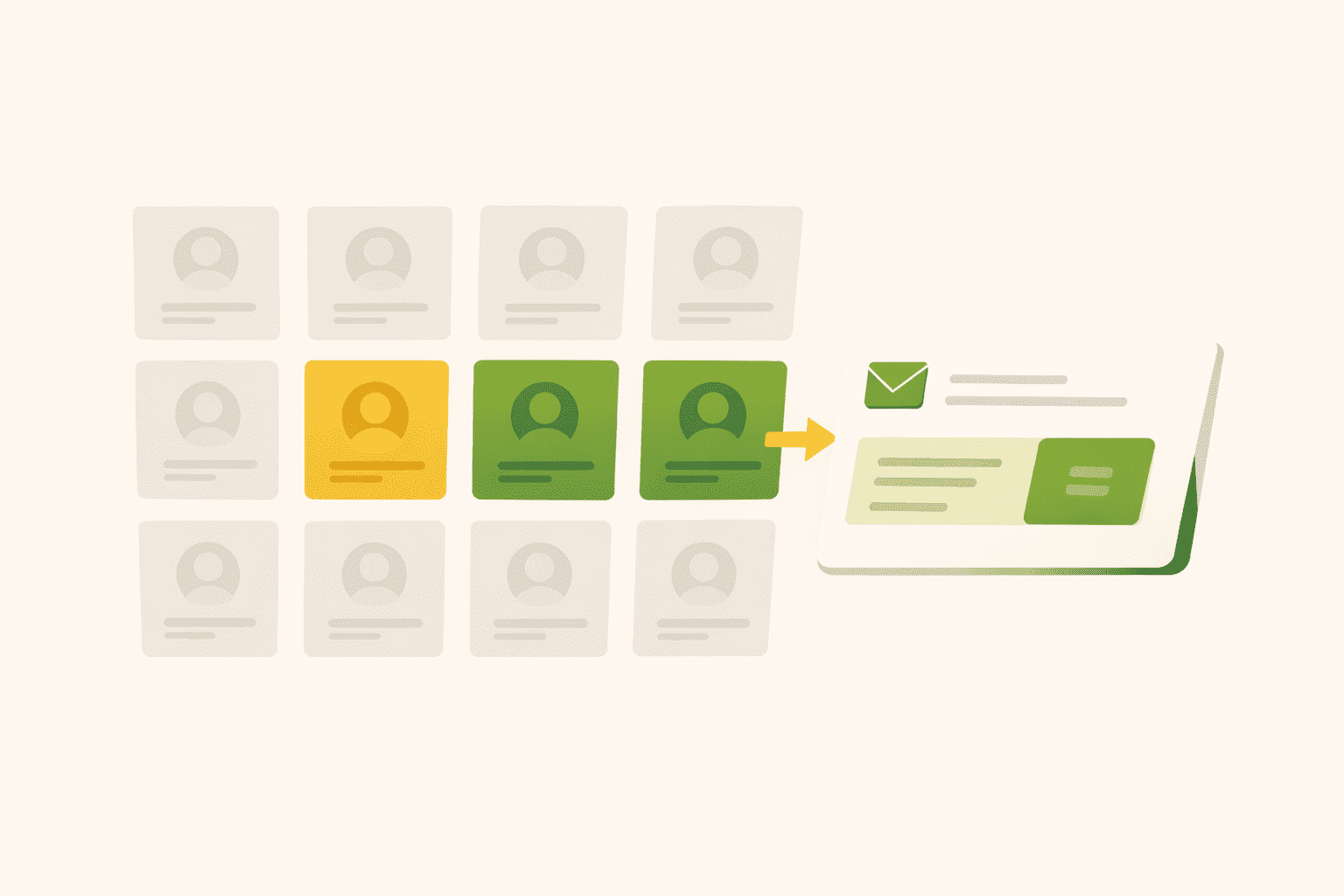
Some of your best future customers already know you. They just drifted. Here’s how to bring them back with a simple three-email sequence.
-
Understand why people drift away
-
Apply the three-email win-back sequence
-
Know when to send a re-engagement campaign
-
Go beyond email: other ways to re-engage
-
Clean your list
You have customers — or subscribers, or clients — who used to buy from you and then stopped. They did not complain. They did not ask for a refund. They did not unfollow you in a dramatic exit. They just quietly drifted away. One month they were there, and the next they were not. And then three months passed, and six, and now you have a growing list of people who once chose you but have not come back.
This is not failure. It is normal. People get busy. Their needs change. They get distracted by something shiny. Their inbox buries your emails. Life happens, and staying top of mind with every past customer is not something any small business can do passively.
But here is what makes those drifted customers so valuable: they already trust you. They have already given you their money, their email, or their time. The hardest part — earning initial trust — is already done. Re-engaging them is significantly easier and cheaper than acquiring brand-new customers. You just need to give them a reason to come back.
Why People Drift Away
Understanding why people leave helps you craft the right message to bring them back. Most people drift for one of a few common reasons.
They forgot about you. This is the most common reason by far. Their life moved on, your emails ended up in a tab they never check, and your business simply fell off their radar. There is no negative emotion — just absence.
Their original need was fulfilled. They bought your product, it served its purpose, and they have not needed to buy again. This is especially common with service-based businesses where the project has a defined end point.
They found an alternative. Another business caught their attention or offered something slightly different. This does not mean they prefer the alternative — it just means the alternative was more visible at the right moment.
They had a mediocre experience. Not bad enough to complain, but not good enough to make them a loyal repeat buyer. The experience was fine, which is not a strong enough emotion to drive a return visit.
Each of these scenarios requires a slightly different approach, but they all share one thing: a well-timed, well-crafted message can bring these people back.
The Three-Email Win-Back Sequence
A re-engagement campaign does not need to be complicated. A simple three-email sequence, spaced over two weeks, is enough to reactivate a significant portion of your dormant contacts.
Email one: The warm reconnection. The purpose of this email is to remind people you exist and show them you have been thinking of them. Keep it friendly, personal, and light on selling.
Subject line: “It has been a while — I have been thinking about you”
Body: A brief, genuine note acknowledging the gap. “I noticed it has been a few months since we connected and I wanted to check in. A lot has happened since then — [mention one or two updates about your business, new products, or improvements]. I hope things are going well on your end. Just wanted to say hello and let you know the door is always open.”
No hard sell. No discount. Just warmth and a reminder that you exist and care.
Email two: The value offer. Send this three to five days after the first email. This time, give them something useful — a tip, a resource, or a piece of content that relates to why they connected with you originally.
Subject line: “Something I thought you might find useful”
Body: Share a blog post, a quick tip, a free resource, or an insight that is relevant to their interests. “I recently wrote about [topic] and thought it might be helpful for you. Here is the key takeaway…” End with a soft invitation: “If there is anything I can help with, I am always just a reply away.”
This email rebuilds the value association. It reminds them why they followed or bought from you in the first place — because you provide something useful.
Email three: The specific offer. Send this five to seven days after the second email. Now you make a direct invitation to take action.
Subject line: “A little something for our reunion”
Body: Present a specific, time-limited offer. A discount, a free bonus, early access to something new, or a complimentary consultation. “I wanted to welcome you back with [specific offer]. It is available for the next [timeframe]. I would love to work with you again.”
This email creates a concrete reason to return and a deadline that encourages action.
When to Send a Re-Engagement Campaign
The right timing depends on your business cycle. A general guideline: if a customer has not purchased or engaged with your emails in 60 to 90 days, they are a candidate for re-engagement. For businesses with longer purchase cycles — like high-end services or seasonal products — extend that to six months.
Do not wait too long. The longer someone has been inactive, the harder it is to bring them back. A customer who drifted away two months ago is much more likely to return than one who has been gone for a year.
Run re-engagement campaigns quarterly. Set a recurring date on your calendar to review your contact list, identify dormant contacts, and send the sequence. This keeps your list healthy and your revenue from past customers flowing.
Beyond Email: Other Ways to Re-Engage
Email is the most effective channel for re-engagement because it is direct and personal. But it is not the only option.
A personalized text message works well for service-based businesses with a small client base. “Hi [name], it has been a while since your last [service]. I have some availability coming up next month if you are ready for another session.”
A retargeting ad on Facebook or Instagram can remind past website visitors that you exist. These ads show up in the feeds of people who have previously visited your site, keeping you visible without requiring their email.
A direct piece of mail — a postcard, a handwritten note, or a small sample — cuts through the digital noise in a way that email cannot. This is particularly effective for local businesses and product-based businesses where a tangible touchpoint makes an impression.
Cleaning Your List
Not everyone will come back, and that is okay. After running a re-engagement campaign, anyone who still does not open your emails or interact with your business is a candidate for removal from your active contact list.
This feels counterintuitive — why would you remove contacts you worked hard to get? Because a large list of unengaged people hurts more than it helps. It drags down your email open rates, costs you money if you pay per subscriber, and skews your data. A smaller, active list outperforms a large, stale one every time.
Before removing dormant contacts, send one final email with a clear subject line: “Should I keep sending you emails?” or “Is this still the right email for you?” Anyone who responds or clicks stays. Anyone who does not gets moved to an inactive list or removed entirely.
The Action Step
Identify the segment of your email list or customer database that has not purchased or engaged in the last 90 days. Write the three-email win-back sequence using the framework above — warm reconnection, value offer, specific invitation. Schedule them to send over the next two weeks.
Then put a quarterly reminder on your calendar to repeat this process. Every time you run a re-engagement campaign, some of those dormant contacts will wake up. And every customer who comes back is one you did not have to spend a dollar acquiring. They were already yours — they just needed to be invited back.
Try It With AI
Ready to put this into action? Copy any of the prompts below, paste it into ChatGPT or Claude, fill in the [BRACKETS] with your info, and hit send. You will have a solid first draft in minutes.
Prompt 1: Write a warm reconnection email acknowledging the gap and showing what’s new with your business:
I’m re-engaging customers who went dormant on my email list. I run a [TYPE OF BUSINESS]. Since they last bought/engaged, I’ve [WHAT’S NEW – new products, improvements, updates]. Write a warm, friendly reconnection email (no sales pitch) that: 1) Acknowledges it’s been a while, 2) Shows I’ve been thinking of them, 3) Mentions 1-2 updates about my business, 4) Keeps the door open without pressure. Subject line: ‘It’s been a while – I’ve been thinking about you’
Prompt 2: Write a second email sharing valuable content (tip, resource, or insight) relevant to why they connected with you:
For my second re-engagement email, I want to remind past customers why they loved me. I run a [TYPE OF BUSINESS] and help people with [MAIN PROBLEM/TOPIC]. Write a short email (150-200 words) that shares a valuable tip or insight related to [SPECIFIC TOPIC they care about]. Include a soft call-to-action like ‘if there’s anything I can help with, I’m a reply away.’ Subject line: ‘Something I thought you might find useful’
Prompt 3: Write a third email with a specific, time-limited offer to win them back:
For my final re-engagement email, I want to give them a reason to come back. I run a [TYPE OF BUSINESS]. Write an email that presents a specific offer: [OFFER – discount, bonus, free consultation, early access, etc.] available for [TIMEFRAME]. Make it feel like a special welcome-back deal, not desperate. Subject line: ‘A little something for our reunion’
