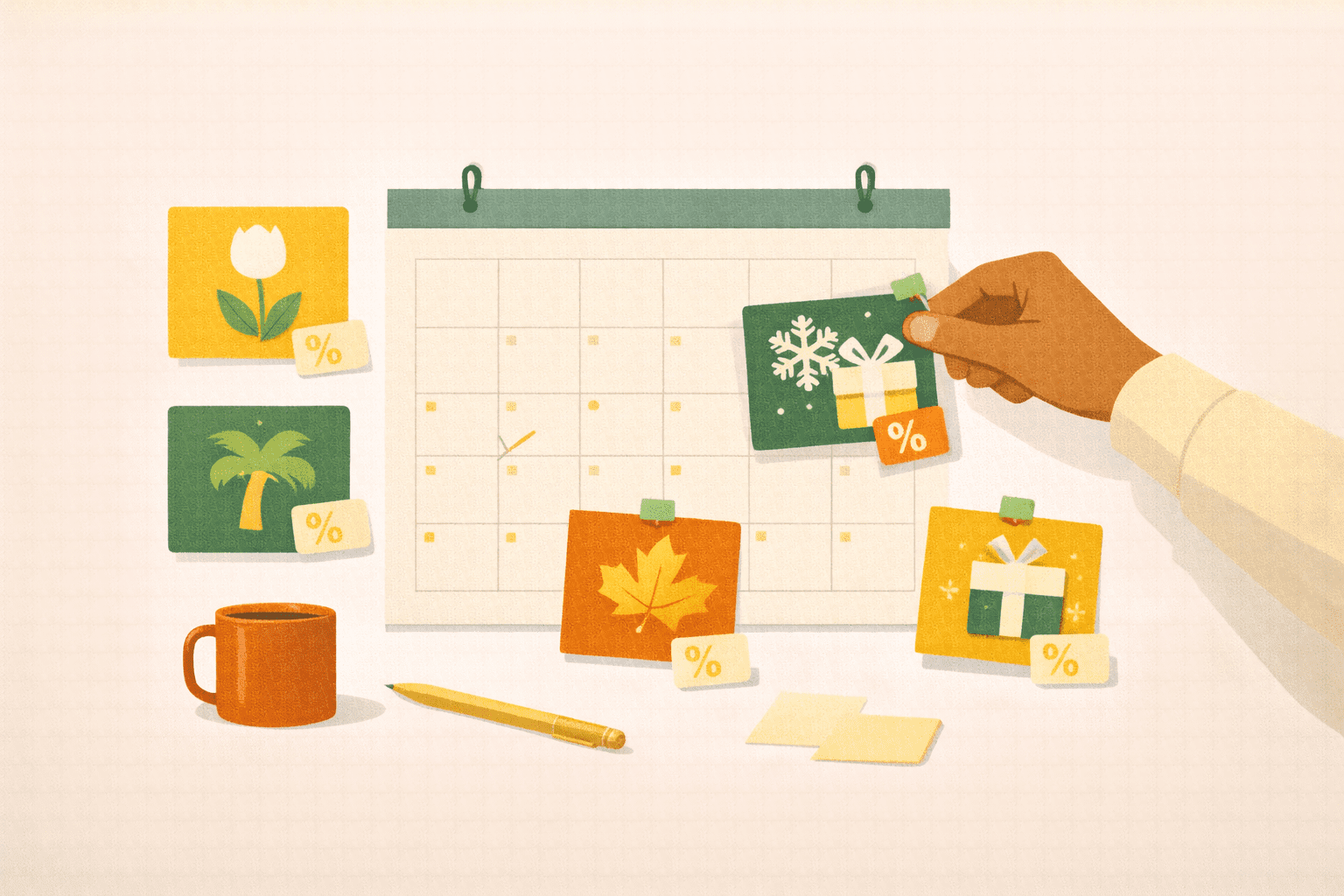
Running a sale feels like the obvious move when a big shopping season hits. But discounts aren’t the only way to create urgency.
-
Apply the discount trap
-
Better ways to create urgency
-
Know when discounts make sense
-
Planning a seasonal promotion
-
After the promotion
The holidays are coming. Or a new season is starting. Or a big shopping event is approaching. And the question hits you: should you run a sale?
On one hand, everyone else seems to be slashing prices. Customers expect discounts. A good promotion could bring in a rush of revenue. On the other hand, you have worked hard to position your business as quality-focused, and the idea of plastering “50% OFF EVERYTHING” across your website makes you cringe.
You are right to be cautious. Promotions done poorly can train your audience to wait for the next sale instead of buying at full price. They can attract bargain hunters who will never return. They can undermine the value you have spent months or years building.
But promotions done well can drive real revenue, reward loyal customers, attract new ones, and create genuine excitement around your brand. The difference comes down to strategy.
The Discount Trap
The most common promotional mistake is defaulting to a straight percentage off. 20% off everything. 30% off for Black Friday. Half off end-of-season clearance. It is simple, and it works in the short term.
The problem is what it teaches your audience over time. If you run a 20% off sale every quarter, your customers learn the pattern. They stop buying at full price because they know a discount is coming. Your regular pricing starts to feel inflated, and the discounted price becomes what people believe your products or services are actually worth.
This is especially damaging for service-based businesses and premium products where perceived value is a key part of the offering. A life coach who regularly discounts sessions sends the message that the full rate was negotiable all along.
Better Ways to Create Urgency
Urgency is what makes promotions work. People need a reason to buy now instead of later. But urgency does not have to come from a lower price. It can come from scarcity, exclusivity, or added value.
Limited-time bundles. Instead of discounting a single product or service, create a special bundle that is only available during the promotional period. A photographer might offer a fall mini-session package that includes 15 minutes, 10 edited images, and a set of digital holiday cards — available for one week only. The price is fair (not discounted), but the package is unique and time-limited.
Bonus offers. Add something extra instead of subtracting from the price. A baker could offer a free box of cookie samples with every holiday order over a certain amount. A consultant could include a bonus follow-up call with a seasonal package. The customer gets more value without you training them to expect lower prices.
Early access for loyal customers. Give your email list or repeat customers first access to a new product, service, or limited-edition offering before it goes public. The exclusivity creates urgency and rewards the people who already support your business.
Gift with purchase. A small, branded gift that comes with orders during the promotional period. It could be a sample, a sticker, a printed card, or anything that adds a thoughtful touch. The gift feels special without devaluing what you sell.
When Discounts Make Sense
This is not a blanket argument against ever lowering prices. There are situations where a discount is the right strategic move.
Clearing inventory. If you have physical products that need to move — end-of-season items, overstock, discontinued products — a clearance sale makes practical sense. Just separate it clearly from your current offerings so it does not dilute the perceived value of your new or core products.
First-time customer offers. A small introductory discount for new customers can reduce the risk of trying your business for the first time. “10% off your first order” is a well-established strategy because it lowers the barrier without setting an expectation of ongoing discounts.
Rewarding loyalty. A private discount for repeat customers — not advertised publicly — feels like a thank-you rather than a devaluation. “As a thank you for being a return customer, here is 15% off your next order.” This strengthens the relationship without training the broader market to wait for sales.
Launching something new. An introductory price for a new product or service — explicitly framed as a launch price that will increase — creates urgency to buy now while clearly communicating that the full value is higher.
Planning a Seasonal Promotion
The best promotions are planned, not reactive. Here is a simple framework for building one.
Decide the goal. Are you trying to increase revenue? Attract new customers? Reward existing ones? Move excess inventory? The goal determines the type of promotion.
Choose the mechanic. Based on your goal, pick the right approach — bundle, bonus, early access, discount, or gift with purchase. Match the mechanic to your brand positioning.
Set clear boundaries. When does the promotion start? When does it end? What is included? What is excluded? Clear boundaries create urgency and prevent the promotion from dragging on indefinitely, which kills urgency.
Communicate the value. Whatever your promotion is, explain why it is special and why it is only available now. “Our holiday cookie gift box includes six seasonal flavors we only make in December” is more compelling than “cookies on sale.” The story behind the offer matters.
Promote it with a timeline. Announce the promotion before it starts. Remind people during it. Send a “last chance” message before it ends. Most purchases happen in the first and last 24 hours of a promotion — make sure your audience knows both dates.
After the Promotion
Every promotion generates data you can learn from. How many new customers did it bring in? How many repeat customers participated? What was the average order value? Did you hit your revenue goal?
Pay attention to what happens in the weeks after the promotion ends. If sales drop dramatically, it might mean you trained people to wait for the next deal. If sales return to normal, the promotion generated a healthy boost without creating dependency.
Also track which new customers from the promotion come back and buy at full price. These are the ones worth cultivating. Bargain-only customers who never return are not the audience you want to build a business around.
The Action Step
Pick your next natural seasonal moment — a holiday, a change of season, an anniversary of your business launch — and plan a promotion that does not rely on a straight discount.
Think about what you could offer as a bundle, a bonus, or an exclusive experience. Set your dates. Write the announcement email. Plan two to three reminder posts for social media.
You can create excitement and urgency without giving your work away. The key is making people feel like they are getting something special — not that your regular pricing was too high all along.
Try It With AI
Ready to put this into action? Copy any of the prompts below, paste it into ChatGPT or Claude, fill in the [BRACKETS] with your info, and hit send. You will have a solid first draft in minutes.
Prompt 1: Plan a seasonal promotion that does not rely on a straight discount:
Help me plan a seasonal promotion for my [TYPE OF BUSINESS] business. Instead of a percentage discount, I want to offer something special during [SEASON/OCCASION]. My goal is to [INCREASE REVENUE/ATTRACT NEW CUSTOMERS/REWARD LOYAL CUSTOMERS]. What bundle, bonus offer, or exclusive experience would work well? Keep in mind my customers are [DESCRIBE YOUR IDEAL CUSTOMER].
Prompt 2: Create a promotional announcement email:
Write an announcement email for my [SEASON] promotion. I’m offering [WHAT YOU’RE OFFERING] and it’s only available [TIME PERIOD]. The promotion is special because [WHY IT’S UNIQUE]. My business is [YOUR BUSINESS TYPE]. Make it exciting but not pushy.
Prompt 3: Write social media reminder posts for the promotion:
Create 2-3 social media posts reminding people about my [SEASON] promotion. I’m offering [WHAT YOU’RE OFFERING] until [END DATE]. Post 1 should go out [DATE]. Post 2 should go out [DATE]. Post 3 should be a last-chance reminder. Keep them conversational and focus on the value, not the discount.
