Bookmark this: what actually works on every platform, right now, in plain language you can use today.
- 5 universal rules that work across every social platform
- Platform-specific breakdown: Facebook, Instagram, TikTok, YouTube, Pinterest, LinkedIn
- Post length, frequency, and timing for each platform
- Quick-win tactics that take 15 minutes and get real results
- One-page reference table you can bookmark and screenshot
You picked your platform (and if you haven't, start here). Now you're staring at a blank screen thinking… what do I actually post?
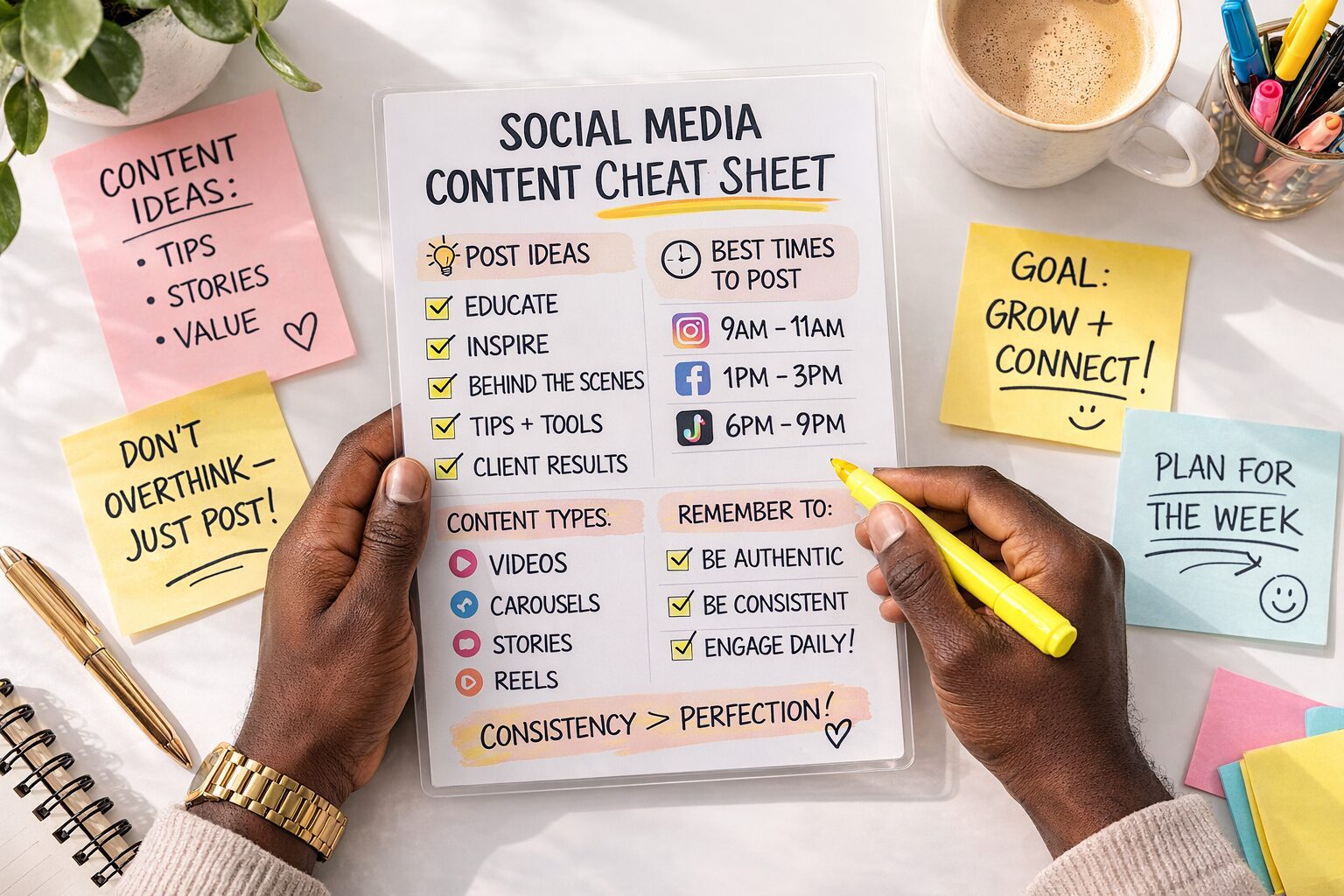
This cheat sheet gives you the quick answers. Bookmark it, screenshot it, tape it to your monitor. It covers what works on each platform right now, in plain language, so you can stop guessing and start posting.
The Universal Rules (These Work Everywhere)
Before we get into platform-specific tips, here are five things that work no matter where you post:
-
Lead with the result, not the product. Don't say "I sell candles." Say "I help busy women turn their living room into a daily escape." People scroll past products. They stop for results.
-
Talk to one person, not a crowd. Write your post like you're texting a friend, not giving a speech. "You" is your most powerful word.
-
The first line is everything. On every platform, the first line determines whether someone reads the rest. Make it a hook — a question, a bold statement, a surprising fact.
-
Three posts a week beats seven random ones. Consistency matters more than volume. Three intentional posts per week will outperform daily posts that have no plan behind them.
-
Every post should do ONE of three jobs: teach something useful, share something personal, or tell people what you sell. That's the whole strategy.
Best post types:
- Text posts with a personal story (Facebook's algorithm favors conversation starters)
- Questions that invite comments ("What's one thing you wish someone told you when you started?")
- Short videos (under 3 minutes)
- Facebook Group posts that help people, not sell to them
Post length: 40-80 words for engagement. Up to 300 words for storytelling posts. Questions and short stories get the most comments.
Posting frequency: 3-5 times per week
Best times to post: Weekday mornings (7-9 AM) and evenings (7-9 PM) tend to work well. But test what works for your audience — every audience is different.
What to avoid: Posting links in the caption (Facebook deprioritizes posts that try to send people off-platform). Instead, put the link in the first comment.
Quick win: Join 3-5 Facebook Groups where your ideal customer hangs out. Spend 15 minutes a day being genuinely helpful in those groups. Answer questions. Share tips. Don't pitch. When people see you being helpful repeatedly, they'll come find your page on their own.
Best post types:
- Reels (short videos, 15-60 seconds) — these get the most reach right now
- Carousel posts (swipeable images with tips, steps, or lists — great for teaching)
- Stories (behind-the-scenes, polls, questions, daily check-ins)
- Single image posts with longer, story-driven captions
Caption length: Instagram captions can be up to 2,200 characters. Longer captions with substance often outperform short ones. Tell a mini story. Give a tip. End with a question.
Posting frequency: 3-5 feed posts per week, plus daily Stories if you can manage it
Hashtags: Use 5-15 relevant hashtags. Mix broad ones (#smallbusiness) with specific ones (#handmadecandles, #blackownedbeauty). Put them at the end of your caption or in the first comment.
What to avoid: Posting beautiful photos with no context. Instagram is a conversation platform now, not just a photo gallery. Every post needs substance — a lesson, a story, or a clear reason to engage.
Quick win: Create a 3-slide carousel post that teaches something useful. Slide 1: a bold statement or question (the hook). Slide 2-3: the answer or tip. This format consistently gets saved and shared.
TikTok
Best post types:
- "How to" tutorials (show people how to do something in under 60 seconds)
- "Things I wish I knew" or "mistakes I made" videos
- Before/after reveals
- Behind-the-scenes of your process
- Day-in-the-life of running your business
Video length: 15-60 seconds is the sweet spot for newer accounts. Once you build an audience, you can go longer.
Posting frequency: 3-7 times per week (TikTok rewards frequent posting more than other platforms)
What to avoid: Over-producing your videos. TikTok rewards authenticity. A video shot on your phone with good lighting will outperform a professionally edited ad. Also avoid starting with "Hey guys!" — start with the hook immediately.
Quick win: Film three "quick tip" videos this week using this formula: "Here's something most people don't know about [your topic]…" — then share one useful fact or tip. Keep each video under 30 seconds.
YouTube
Best post types:
- How-to tutorials (step-by-step guides)
- "Best of" or comparison videos
- YouTube Shorts (under 60 seconds — similar to TikTok/Reels)
- Q&A videos answering common questions from your audience
Video length: 8-15 minutes for long-form videos (YouTube's algorithm favors longer watch time). Under 60 seconds for Shorts.
Posting frequency: 1-2 long-form videos per week, or 3-5 Shorts per week
Titles and thumbnails: Your title and thumbnail determine whether anyone clicks. Use specific, benefit-driven titles: "How to Start an Email List in Under an Hour (Free Tools)" is better than "Email Marketing Tips."
What to avoid: Waiting until everything is perfect to start. Your first videos won't be your best — that's normal. Getting started matters more than getting it perfect.
Quick win: Answer the #1 question your customers ask you, on camera, in under 10 minutes. Upload it with a clear, specific title. That single video can bring you customers for years.
Best post types:
- Tall images (2:3 ratio) with text overlay describing the content
- Infographics and step-by-step visual guides
- Product photos with clear descriptions
- Blog post graphics that link back to your website
Pin description length: 100-500 characters. Include keywords naturally — Pinterest is a search engine, so write your descriptions the way someone would search for your content.
Posting frequency: 5-15 pins per week (you can pin other people's content too, not just your own)
What to avoid: Treating Pinterest like Instagram. Pinterest is a search and discovery tool, not a social conversation platform. People come to plan and find solutions, not to chat. Focus on search, not engagement.
Quick win: Create 5 pin images for your best piece of content (blog post, guide, or product page). Each pin should have different text and visuals but link to the same URL. This gives you 5 chances to be discovered instead of one.
Best post types:
- Personal stories with a professional lesson ("Here's what I learned when…")
- Contrarian takes on common industry advice
- Step-by-step frameworks or processes
- Carousel documents (PDF posts that people swipe through)
Post length: 150-300 words tends to work well. Start with a strong first line — LinkedIn only shows the first 2-3 lines before the "see more" button.
Posting frequency: 3-5 times per week
What to avoid: Sounding like a press release. LinkedIn rewards personal, authentic content — not corporate-speak. Write like you're talking to a colleague over coffee.
Quick win: Write a post that starts with "Most people think [common belief]. Here's what I've learned instead:" — then share your honest experience. This formula consistently sparks conversation on LinkedIn.
Your One-Page Cheat Sheet
| Platform | Best For | Post Frequency | Top Format |
|---|---|---|---|
| Community, 35+ audience | 3-5/week | Stories + Groups | |
| Visual products, lifestyle | 3-5/week + Stories | Reels + Carousels | |
| TikTok | Discovery, authenticity | 3-7/week | Short tutorials |
| YouTube | Evergreen education | 1-2/week or 3-5 Shorts | How-to videos |
| Products, driving website traffic | 5-15 pins/week | Tall images + infographics | |
| B2B, professional services | 3-5/week | Personal stories |
What to Do Next
- Pick your ONE platform (if you haven't already).
- Use the cheat sheet above to plan your first 3 posts this week.
- Need the posts written for you? Grab The ChatGPT Cheat Code — Prompt #6 gives you a full month of content in about 15 minutes.
Try It With AI
Ready to put this into action? Copy any of the prompts below, paste it into ChatGPT or Claude, fill in the [BRACKETS] with your info, and hit send. You'll have a solid first draft in minutes.
Prompt 1: Create a Sample Post:
I’m creating a [PLATFORM] post for [YOUR BUSINESS]. The post should teach something useful about [TOPIC]. It needs to [PLATFORM-SPECIFIC REQUIREMENT, e.g., ‘be under 60 seconds’, ‘be 3-4 paragraphs’, ‘include a carousel format’]. Write the post in a way that sounds like me talking to a friend, not like a brand talking to customers.
Prompt 2: Write Multiple Variations:
I need 3 different posts for [PLATFORM] that work for [YOUR BUSINESS]. One should teach something. One should be personal. One should mention what I sell. Each post should follow the format and length recommendations for [PLATFORM]. Make each one feel different but all in my voice.
Prompt 3: Optimize for Your Platform:
I wrote this post for [PLATFORM]: [PASTE YOUR POST]. Looking at the cheat sheet for [PLATFORM], what am I doing right? What could I improve? Should I add hashtags? Change the length? Add a question at the end? Give me specific, actionable feedback.
This cheat sheet works because it’s simple. Print it, bookmark it, tape it to your monitor. Every rule here is tested and real. When you follow it, your posts will stand out.
