A real sales page explains clearly why someone needs what you made. That’s not pushy. That’s kind.
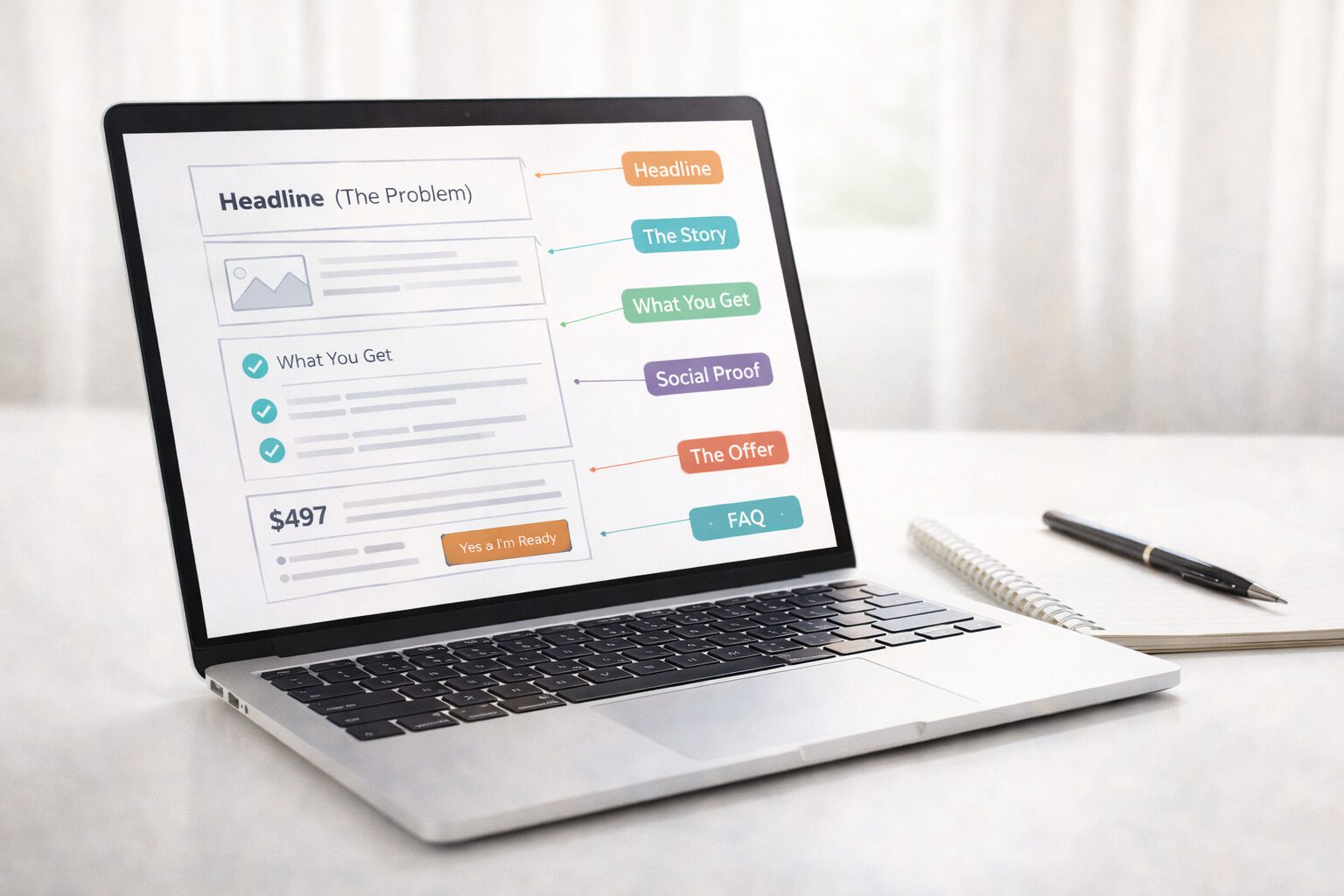
- The 5-part formula that converts (problem, consequences, solution, proof, ask)
- How to write each part without sounding sleazy
- Real examples of bad vs. good sales copy
- Why your voice matters more than any ‘sales voice’
- How to get feedback before you launch
You've built your product. You've priced it. Now you need to tell people about it in a way that actually makes them want to buy.
This is where a lot of creators freeze up. The word "sales" feels slippery. "Sales page" sounds like something a used car salesman writes. And the idea of "selling yourself" feels like showing up to a party in a cheap suit asking everyone to buy something they don't need.
That's not what a sales page is.
A real sales page is honest writing that helps someone understand whether what you made is right for them. That's it. It's not manipulation. It's not tricks. It's clarity.
And here's the truth: most people feel relief when someone explains clearly what they're offering and why it matters. Clarity is kind. Vagueness is what actually feels pushy.
Why You Need a Sales Page (Not Just a Product Page)
Let's start with the difference, because it matters.
A product page tells people what it is: "Email Course: 5 Days of Email Copywriting Tips."
A sales page tells them why they need it and why your version is the one to choose.
People don't buy things because they exist. They buy things because they believe the thing will solve a problem or help them feel differently. Your sales page connects what you made to what they actually want.
That's not manipulation. That's actually helpful.
Think about something you've bought recently. A skincare product. A book. A class. Why did you choose that one? You read reviews or a description that made you believe it would help you. That description—that's a sales page. It worked because it was honest and specific.
The 5-Part Formula That Works
Here's the structure that works for almost every product. It's not fancy, and that's the point.
Part 1: The Problem (Start Here)
Your sales page opens with a problem. Not your product. Not your name. The problem.
Here's what that looks like:
"You've been trying to grow your email list for months. You're putting content out there. People are reading it. But when you ask them to sign up for your email, most of them say no. And the ones who do sign up? You have no idea what to send them."
Notice what just happened. If you've experienced that, you felt a little spark of recognition. Like someone finally gets it. That's powerful.
Start with the real problem your audience faces. Be specific. Use their words. Show that you understand what it's actually like to be stuck there.
Bad version: "Growing an audience is hard."
Good version: "You're creating good content. It's not the content that's the problem. It's that nobody's asking to hear from you again."
The good version is specific and true and makes people nod.
Part 2: The Consequences (Paint the Picture)
Now, talk about what happens if they don't solve this problem.
This is not fear-mongering. It's reality.
"If you don't figure out how to get people on your email list, you're stuck. You can't tell your audience about what you're selling. You can't build a real relationship with them. You're always starting from scratch to find new customers."
This is where people think about what's at stake. It's usually true, and saying it out loud helps them realize they actually need to fix this.
Part 3: The Solution (Your Product)
Now you introduce what you made.
But—and this is important—you lead with how it works, not just what it is.
Instead of: "Our Email Growth Accelerator is a 5-week course with video modules and worksheets."
Try: "There's a simple process to build an email list that people actually want to join. First, you identify the one specific thing your people need help with. Second, you create a small piece of that solution for free—something so useful they'd pay for it if they had to. Third, you ask the people who love that free thing if they want to hear from you every week. Most say yes."
See the difference? You're explaining the solution before you explain the product. The product is just the vehicle for the solution.
Then, mention what's included: "In this course, I walk you through each of those three steps. You get the exact email templates I use, the 'permission-asking' script that gets the most yeses, and three real examples of this working for coaches, course creators, and product sellers."
Specific details beat vague benefits every time.
Part 4: The Proof (Why You Should Believe This)
This is where real social proof lives. And I don't mean fake testimonials. I mean actual evidence.
If people have used what you're selling and it worked, say so. Get specific about the results.
"Margaret, a yoga instructor, used this system and went from 40 email subscribers to 340 in six months. She didn't spend money on ads. She used the free resource strategy we outline in module two."
Or: "I used this system to build an email list of 8,000 people in two years while working full-time at another job. Here's the email from last week when I let them know I was launching a new course: 250 people bought it in the first week."
Real proof. Real numbers. Real people (when you have permission to name them).
If you don't have customer stories yet because this is your first launch, that's okay. Be honest about it.
"I've tested this system with five people in beta. Here's what they said: [real quotes from them]."
Or: "I've been using this exact process to build my own email list for three years. This course is the system I wish I'd had when I started."
Honesty is proof too.
Part 5: The Ask and the Next Step (Make It Easy)
Now you tell them how to buy.
This is the part where people get weirdly apologetic. They write things like: "If you feel like this might be for you, maybe consider checking it out?"
No.
Be clear and direct: "The Email Growth Accelerator is $67. You get everything above. You can start today. Here's the buy button."
Then tell them exactly what happens next, step by step.
"When you buy, you'll get instant access to all five weeks of videos. You'll also get my weekly email with new ideas you can implement that week. Most people see their first email signups within the first module."
People want to know what to expect. Tell them.
And then: "Buy the course" or "Get started here" or "Join today." Not "maybe click here if you want." Clear words. One clear button.
Real Examples: Good vs. Bad Sales Copy
Let me show you what this looks like in practice.
Bad Sales Copy:
"The Social Media Mastery Bundle includes everything you need to grow on Instagram and TikTok. Learn from an expert. Get templates. Transform your strategy. This is the course you've been waiting for."
Why it's bad: It's all fluff. "Expert," "everything," "transform"—these words don't actually mean anything. It doesn't tell me why I need it or what problem it solves.
Good Sales Copy:
"Your Instagram posts are getting maybe 30 likes. You spend 45 minutes writing each one. And the followers you get seem random—they don't engage and they definitely don't buy anything. That's because there's a formula to Instagram that nobody teaches, and you're guessing at every post. In this course, I break down exactly how the Instagram algorithm actually works (not what Instagram tells you). Then I show you the 10 post structures that get consistent engagement and follower growth. Finally, I share the three types of posts that actually make people want to buy from you. You'll get the templates, scripts, and the exact content calendar I use for my own account (which went from 2,000 to 50,000 followers in 14 months)."
Why it's good: It's specific. It describes the actual problem with real details. It says what you'll get and how it works. It includes proof (50,000 followers). The person reading it believes this is made for them.
The Voice You Use Matters
Here's something that doesn't get said enough: your sales page should sound like you.
If you talk to friends like you're teaching them something, write your sales page that way.
If you're funny in real life, let a little humor in.
If you're direct and no-nonsense, be direct.
The worst sales pages sound like they were written by someone selling to strangers at a trade show. The best ones sound like someone who gets it explaining something important over coffee.
Your real voice is actually more persuasive than any "sales voice" you could adopt. People trust people. They don't trust personas.
Technical Things That Actually Matter
Use a real headline. The headline is the first thing someone reads. It should answer the question: "Is this for me?" Make it specific.
Bad: "Transform Your Business"
Good: "How to Write Emails Your Audience Actually Opens (Without Being Spammy)"
Break it into sections. Long paragraphs are hard to read. Use subheadings. Use short paragraphs. Lots of white space. This is how people actually consume information online.
Show, don't just tell. If you say you provide email templates, show a real template. If you say you teach a process, show a real example of that process. People believe what they can see more than what you claim.
Tell the truth about who this is for. "This course is for people who have a business or creative project and want to build an audience that actually engages." This helps the wrong people self-select out. And it helps the right people feel like you made this for them.
Include a real picture of you. Not a professional headshot. A real photo where you look like a human. People buy from people, not from brands.
The Mistakes That Kill Conversion
Writing to impress, not to help. If you're using big words and complex sentences to sound smart, you're doing it wrong. Clarity is always smarter than complexity.
Leaving out the price. I've seen sales pages that never say what something costs. This creates friction. People have to ask. They bounce. Tell them the price.
Making big claims without proof. "Make six figures in six months!" Nobody believes that. "I went from $2,000 to $15,000 a month in the first year using this system"—that's believable.
Trying to sell to everyone. The more general you are, the less specific it is to anyone. Pick your actual audience and write to them.
Being apologetic. "Sorry if this isn't for you" or "I know this might not work for everyone" makes people doubt what you're selling. Confidence is attractive.
How to Get Feedback Before You Launch
Before you put your sales page live, test it.
Send it to three people who match your actual audience. Ask them: "Read this like you're thinking about buying. Tell me what's unclear. Tell me if you believe the proof. Tell me if you'd buy it at this price."
Listen to what they say. If more than one person asks the same question, your sales page doesn't answer it clearly.
You don't have to change everything based on one person's feedback. But patterns matter.
What to Do Next
-
Map out your five-part story. On a piece of paper or in a doc, write one sentence for each part: the problem, the consequences, the solution, the proof, the ask. This is your outline.
-
Write the bad version first. Don't worry about sounding good. Just explain what you made and why someone needs it. You can make it pretty later.
-
Read it out loud. Does it sound like you talking to a friend? If it sounds like corporate marketing, rewrite it. Use your real words.
-
Add specific details. Replace vague words (expert, powerful, amazing) with specific information. Specific is credible.
-
Get feedback and adjust. Show it to three people. Listen to what confuses them. Fix those parts.
-
Set up your launch checklist. Once your sales page is ready, you'll need to coordinate timing, emails, and social posts. Head to Your First Product Launch: The Plain-Language Checklist to make sure you don't miss anything.
Try It With AI
Ready to put this into action? Copy any of the prompts below, paste it into ChatGPT or Claude, fill in the [BRACKETS] with your info, and hit send. You'll have a solid first draft in minutes.
Prompt 1: Map Your Sales Page Story:
Help me map out my sales page for [YOUR PRODUCT]. Using the 5-part formula (problem, consequences, solution, proof, ask), answer: 1) What problem does [YOUR IDEAL CUSTOMER] have?, 2) What happens if they don’t solve it?, 3) How does my product solve it?, 4) What proof do I have it works?, 5) How do I ask them to buy? Give me 1-2 sentences for each part.
Prompt 2: Write Your Sales Page Draft:
Using this outline: [PASTE YOUR 5-PART OUTLINE], write a full sales page. Each part should be 1-2 paragraphs. Make the problem specific and real. Explain the solution like you’re talking to a friend. Include the proof honestly. End with a clear ask. Keep the tone [YOUR VOICE: straightforward, warm, funny, direct].
Prompt 3: Refine for Your Voice:
Here’s my sales page draft: [PASTE DRAFT]. Does it sound like me? Or does it sound like someone selling something? Give me specific feedback on: tone, any words that feel ‘salesy’, places where I need to be more specific, and whether the proof feels real.
Clarity is the kindest thing you can offer. When your sales page makes someone understand immediately whether your product is right for them, you’ve won.
