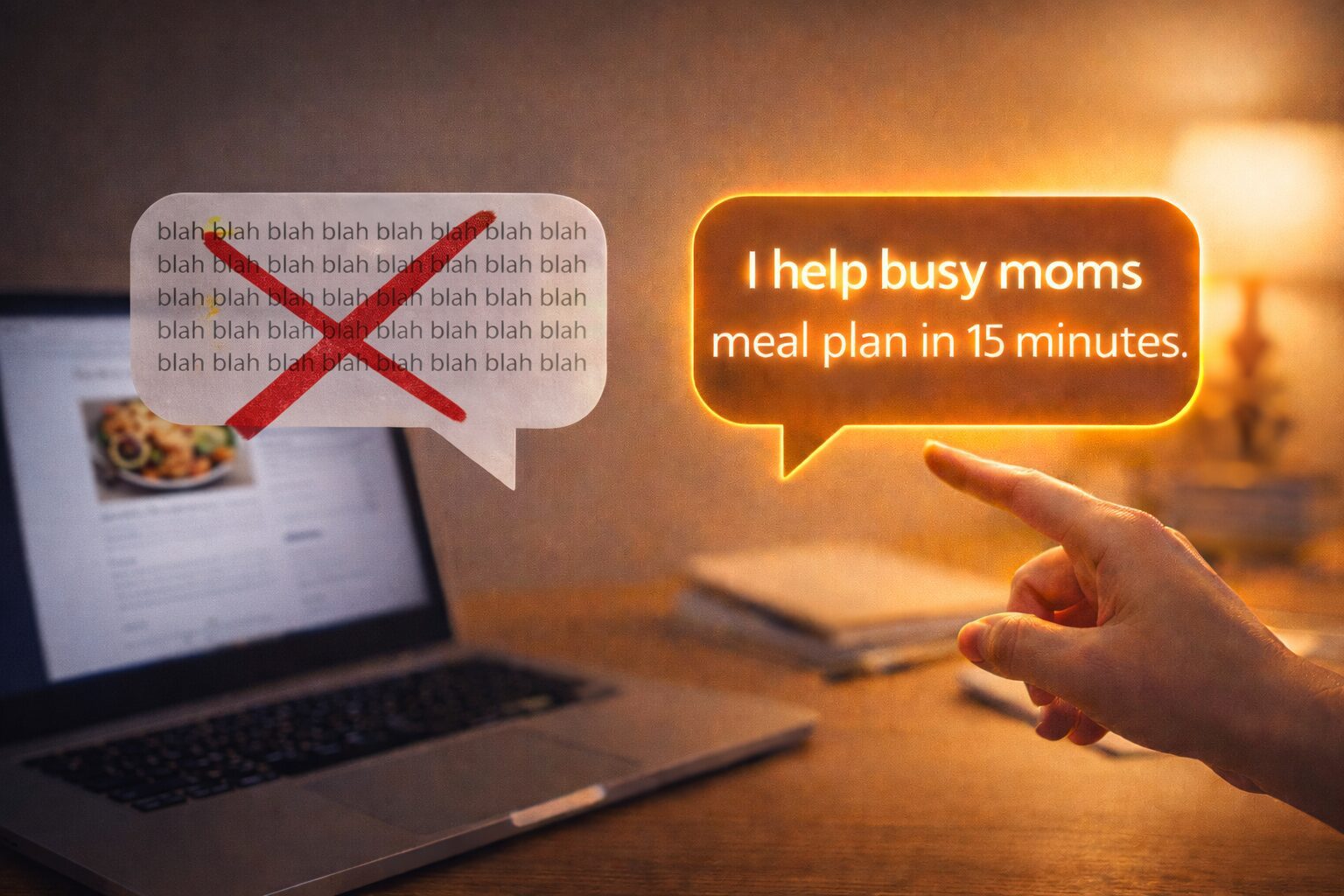
Stop describing what you sell. Start describing what changes for the person who buys. This is the framework that actually works.
- The ‘I help [specific person] [get specific result]’ framework
- How to avoid jargon and buzzwords that make people scroll past
- Real examples from different business types
- The barbecue test: how to know if your description actually works
- How to use this message everywhere (bio, email, website, conversation)
You know that moment when someone asks, "So what do you do?" and you freeze a little bit?
Maybe you're at a family dinner, or a networking event, or bumping into someone at the grocery store. And suddenly you have to explain your business in a way that sounds interesting—not desperate, not boring, not like you're reading from your website.
Most people bomb this moment. They either get too technical and lose the person, or they're too vague and the person doesn't actually know what they do.
But here's what's interesting: the way you answer that question at a barbecue is exactly the way you should be describing what you sell in your marketing. Because the barbecue test is real. If you can't explain your business to a stranger in 30 seconds without them glazing over, then your marketing message isn't working.
The Problem With Feature-First Marketing
Let's say you make candles. Your first instinct is probably to describe your product:
"I make hand-poured, natural soy candles with essential oils and no synthetic fragrances. They're made in small batches. Each candle has a burn time of 40-50 hours."
That's accurate. It's factual. It's also boring, and it doesn't tell anyone why they should care.
Now let's say you describe it differently:
"I make candles that help women wind down at the end of a long day. No artificial junk. Just real scent, good burn time, and a moment of calm that actually works."
Same product. Different focus. One focuses on what the candle is. The other focuses on what the candle does for the person buying it.
The reason this matters is that people don't actually want candles. They want rest. They want to feel better. They want something that works. You sell the result, not the ingredients.
The Framework: "I Help [Who] [Get What Result]"
Here's the simplest, most powerful framework for describing what you sell:
"I help [specific person] [get a specific result]."
That's it. Three parts.
Let's break it down:
Part 1: The Specific Person
Not "entrepreneurs." Not "women." Be specific enough that the right person feels seen.
"Small business owners" is too broad. "Women over 40 who want to start their first business while working full-time" is specific. The right person reads that and thinks, "Oh, she's talking to me."
Part 2: The Specific Result
Not "grow your business" (too vague). Not "increase revenue" (sounds like corporate jargon).
Be specific about what the result actually looks like in real life. "Go from anxious and disorganized to having systems that actually work" is specific. "Get your first 10 clients in 90 days" is specific. "Sleep through the night without worrying about money" is specific.
The more you name the actual feeling or situation the person wants, the more they'll recognize themselves.
Real Examples Across Different Businesses
Let's see how this works for different types of businesses:
A Fitness Trainer
Before: "I offer personal training services with flexibility options."
After: "I help women over 50 feel strong in their own bodies again without the confusion of complicated diets or exhausting workouts."
A Photographer
Before: "I'm a photographer specializing in lifestyle and family portraits."
After: "I help busy parents capture real moments with their kids so they actually have memories they love looking at years from now."
A Baker
Before: "I bake custom cakes for events."
After: "I make cakes that make people stop and say 'wow' at your celebration, and take the stress completely off your plate."
A Business Coach
Before: "I provide business coaching and strategy sessions."
After: "I help solopreneurs who feel stuck go from wondering if their business will make it to actually making real money and having a life outside work."
A Virtual Assistant
Before: "I offer virtual assistant services for small businesses."
After: "I help business owners get back 10 hours a week so they can stop doing admin work and start doing what only they can do."
Do you see the pattern? The "after" version always includes the specific person, the specific result, and the feeling or situation behind it.
The Barbecue Test
Here's how you know your description is working: say it to a stranger.
Not a stranger in a professional context. A actual barbecue or grocery store stranger. Someone who doesn't have to be polite because they're your customer.
If they ask a follow-up question, you're good. "That sounds interesting, can you tell me more?" means your message landed. They understand what you do, and they want to know more.
If they say "Oh, that's cool" and change the subject, go back to the drawing board.
Why This Works So Much Better
When you lead with the result, you're speaking to the thing the person actually cares about. You're saying, "I understand what you need, and I'm the person who can help."
Compare these two messages:
Message 1: "I sell courses on how to start a side business."
Message 2: "I help people over 40 who feel stuck in their jobs build a side business they actually enjoy, so they can have more freedom and more money without burning out."
Which one makes you feel seen if you're that person? Which one makes you think, "Wait, tell me more"?
The second one works because it's not about what the business is. It's about why someone would want it.
How to Craft Yours
Here's a simple process:
Step 1: Finish this sentence: "My customers come to me because…"
Write 2-3 sentences. What's the real problem they're trying to solve?
Step 2: Finish this sentence: "After working with me, they feel…"
Or "After using my product, they can…" Or "After buying from me, they have…"
Step 3: Narrow down your customer.
Instead of "people," who actually buys from you? What's true about them that's specific enough that they'd recognize themselves?
Step 4: Put it together.
"I help [specific person] [get/feel/have specific result]."
Step 5: Test it.
Say it to someone. Does it land? Does it make them curious? Or does it feel like you're reading from your website?
What This Looks Like Across Your Marketing
Once you have this down, use it everywhere:
- In your social media bio. Not a long bio, just the core message.
- In your email signature. Small version, but there.
- In your first email to a new customer or prospect. Lead with this.
- In your website headline. This should be what someone sees first.
- When someone asks what you do. This is your answer.
The key is consistency. When someone sees your message across different places, it reinforces that you know what you're doing and you know who you're doing it for.
The One Thing to Avoid
Don't get cute and don't get vague. Your message should be so clear that a total stranger understands what you do and whether they need it, in 30 seconds.
Avoid words like "innovative," "transformational," or "cutting-edge." Avoid jargon. Avoid saying "I help everyone." Avoid false promises.
Your message should be boring enough to be clear and interesting enough that the right person thinks, "That's for me."
What to Do Next
Now you have a clear message. The next step is learning how to show up consistently with that message, so the right people actually see it.
Read The 3-Post-Per-Week Content System That Actually Works to learn the rhythm that keeps you visible and builds real trust with your audience.
And if you want to speed up the whole process of turning your message into marketing content, grab The ChatGPT Cheat Code at /cheat-code to get the exact prompts for writing emails, posts, and more that actually sound like you.
Try It With AI
Ready to put this into action? Copy any of the prompts below, paste it into ChatGPT or Claude, fill in the [BRACKETS] with your info, and hit send. You'll have a solid first draft in minutes.
Prompt 1: Build Your Core Message:
Help me write my business message. I sell [WHAT YOU SELL] to [YOUR IDEAL CUSTOMER]. They want [SPECIFIC RESULT]. The feeling or situation they’re looking for is [EMOTION/SITUATION: freedom, confidence, clarity, rest, etc.]. Write my message in this format: ‘I help [specific person] [get specific result].’ Make it specific enough that the right person reads it and thinks ‘that’s for me.’
Prompt 2: The Barbecue Test:
Here’s my business message: [PASTE YOUR MESSAGE]. Imagine I’m telling this to a stranger at a barbecue. Does it sound natural? Does it make them curious? Or does it sound like I’m reading from a website? Give me honest feedback and suggest how to make it sound more like me talking to a friend.
Prompt 3: Apply It Everywhere:
My core business message is [YOUR MESSAGE]. Write 4 different versions of this for different places: 1) A social media bio (160 characters max), 2) An email signature version, 3) A website headline, 4) A casual way I’d explain it in conversation. Each should be the same message but adapted for the format.
Clarity is more powerful than cleverness. When someone reads your message and immediately knows if it’s for them, you’ve won. You just learned how to do that.
